Pope to Puglia Day 30 and 31 Bitonto to Bari – 24km Bari to Mola di Barin – 25 km

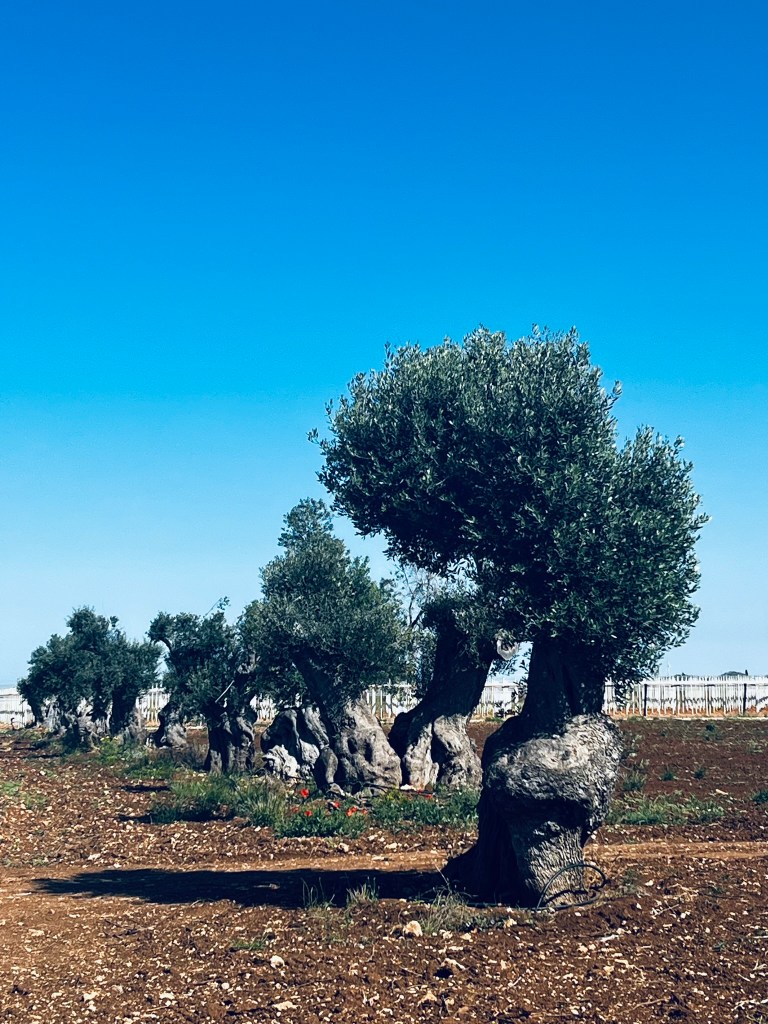
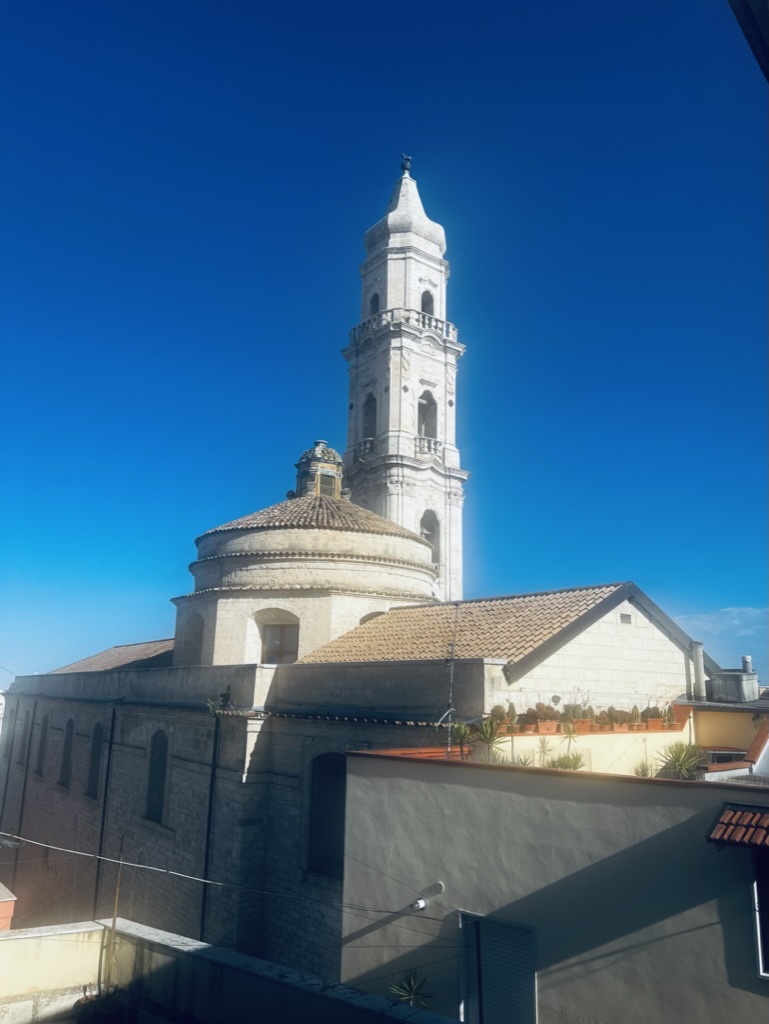
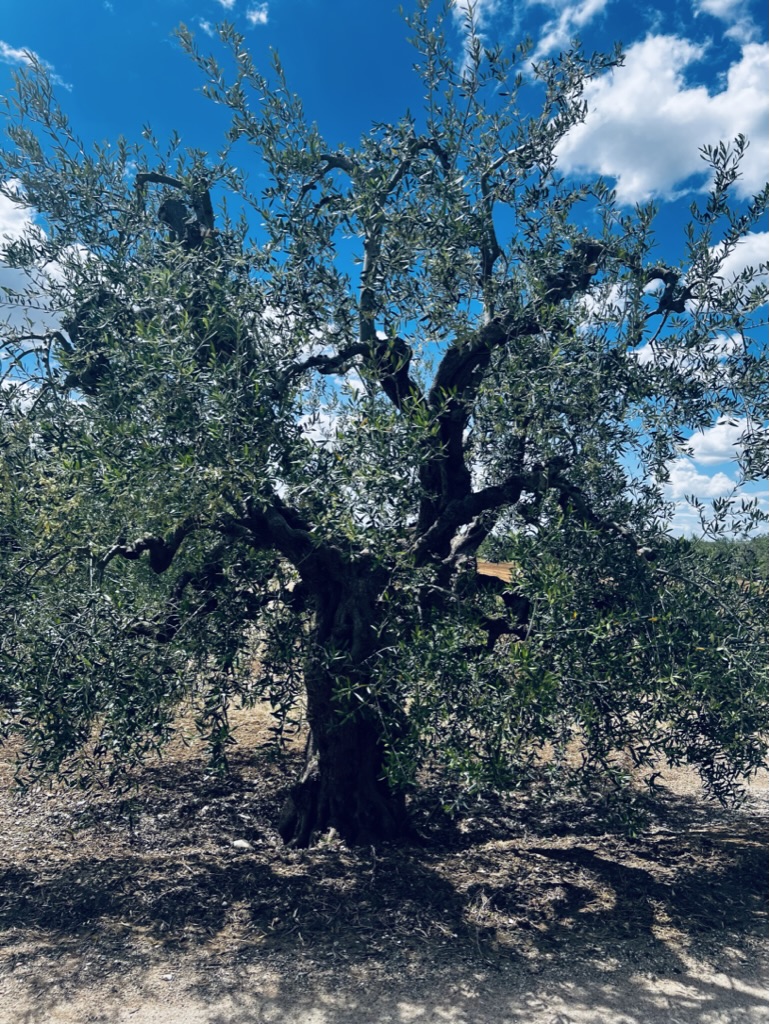
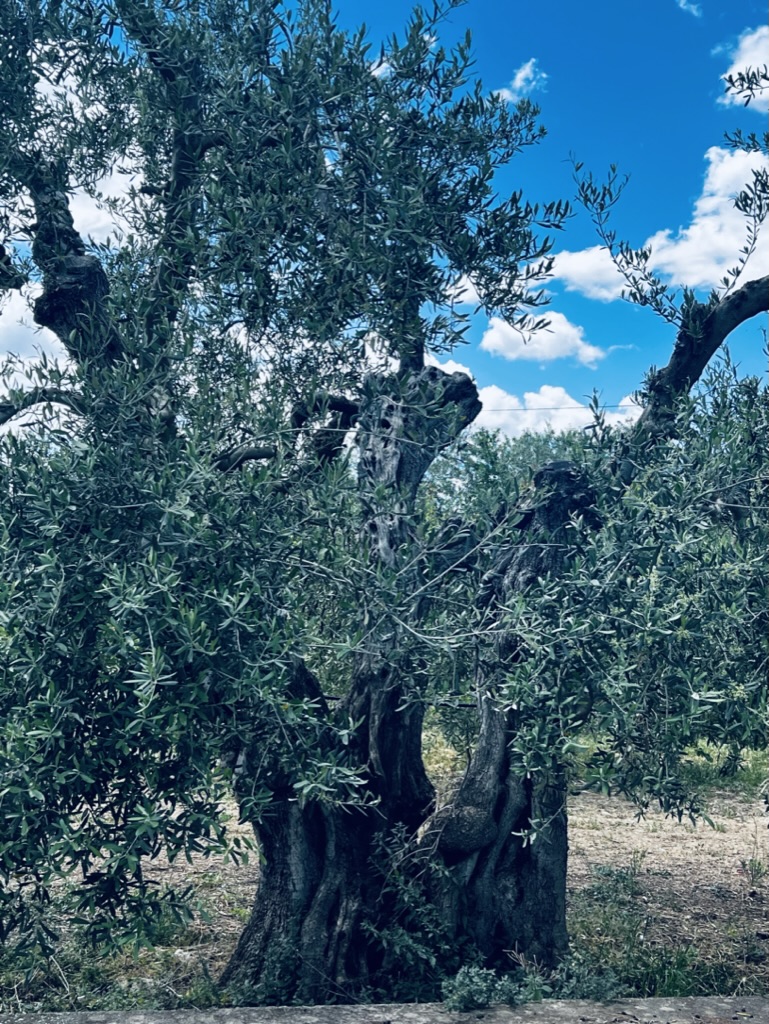
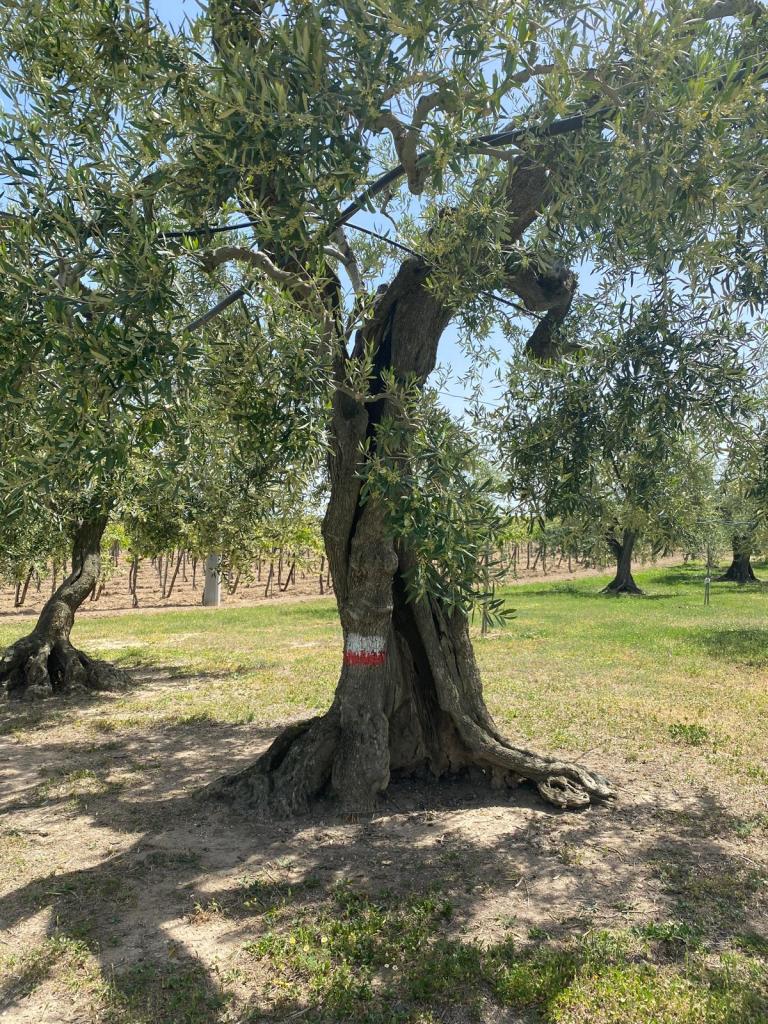
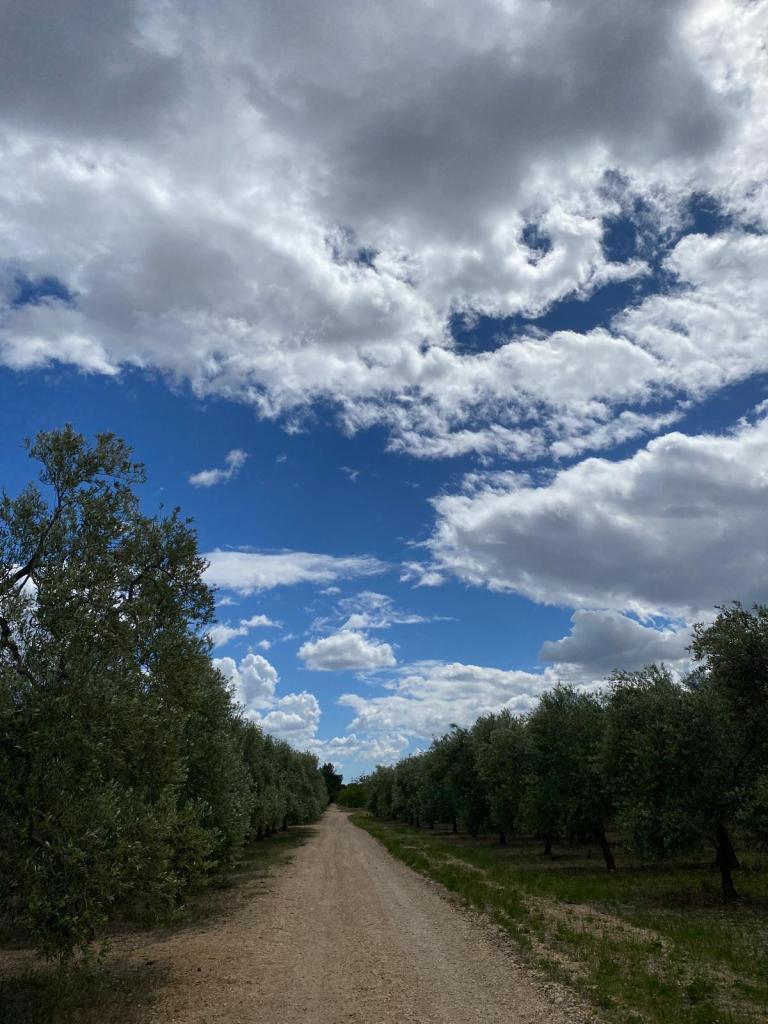
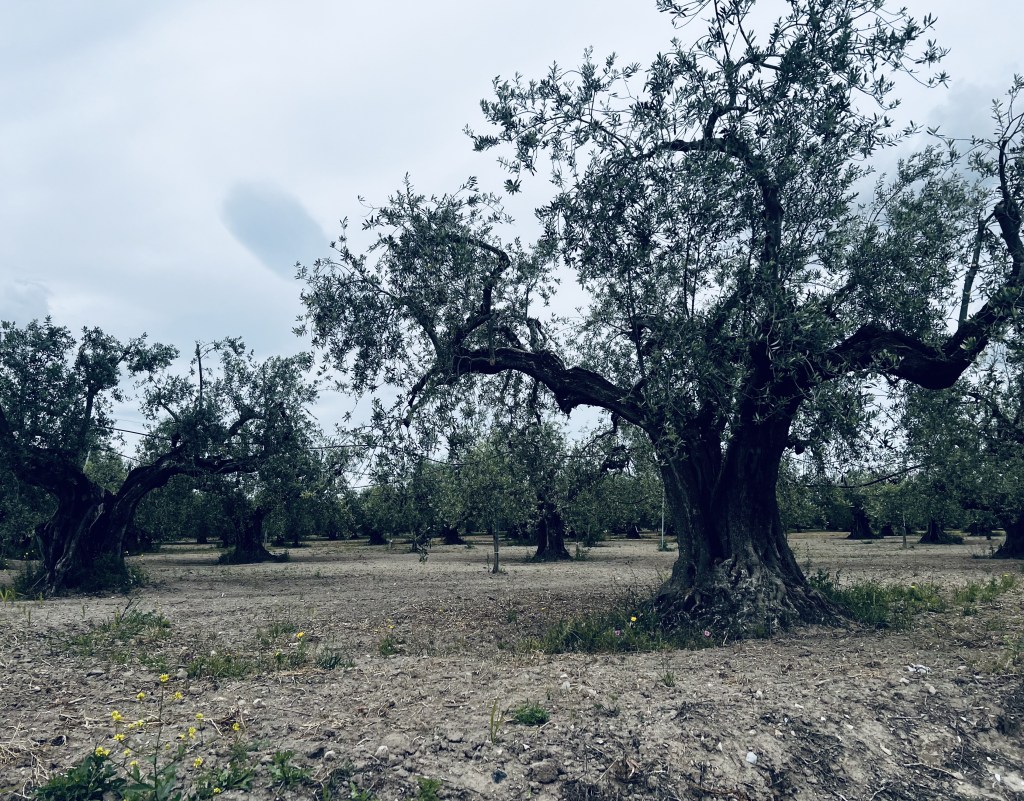
As we approached Bari, the olive trees started resembling what they would look like if Botero sculpted them, still knobby and gnarly but more rotund.  We finally reach the Adriatic Sea once again to walk along an 8 km seaside promenade to the center of Bari, a city whose verve, energy and vitality is a welcome change of pace from the olive tree garden of Eden we strolled through for the last 5 days and yet the abrupt re-entry into a great urban center is disquieting at first.   But we adjust: seaside restaurant, live DJ, fritti misti, pasta vongole, Verdeca.   

Bari is gearing up for the feast of St Nicholas on May 9 when they celebrate the removal of the saint’s relics from Myra to Bari in the 11th century.  St Nicholas is the patron saint of repentant thieves, so it was ok to steal his remains.  Bari is in full party mode, until 2 am under our window.  Even to our weary ears it sounded like fun.

The walk from Bari to Mola di Bari was along the seaside boardwalks that line the Puglian coast.  It was a beautiful day; families were enjoying perhaps their first outing of the spring/summer.  The picnic lunch followed all the customary protocols: table and chairs, tablecloth, glasses and plates and silver wear. Like at home, only on the beach.  The food smelled delicious.    We refrained from stopping for lunch today, so we are off to a seafood restaurant tonight. 

Pope to Puglia Day 29 Ruvo di Puglia to Bitonto – 26 km

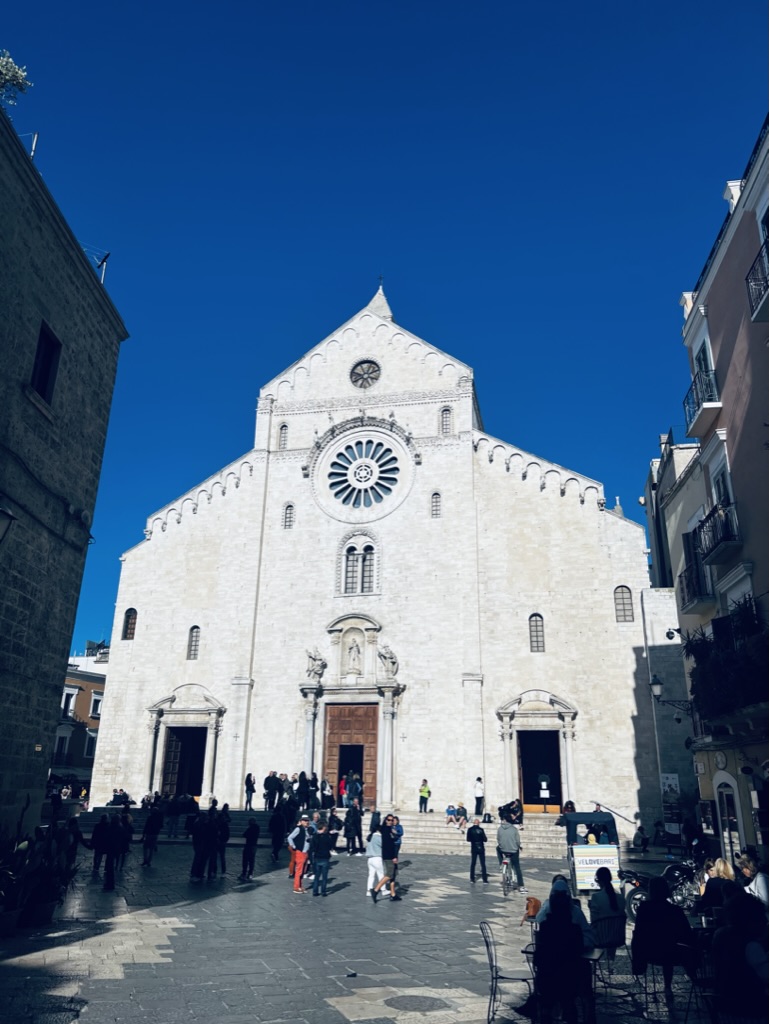
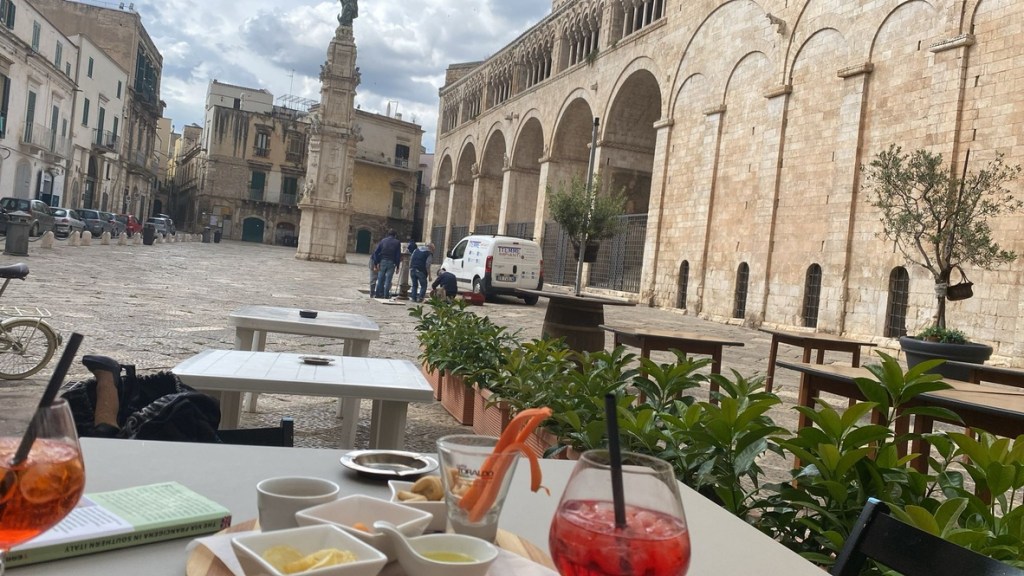
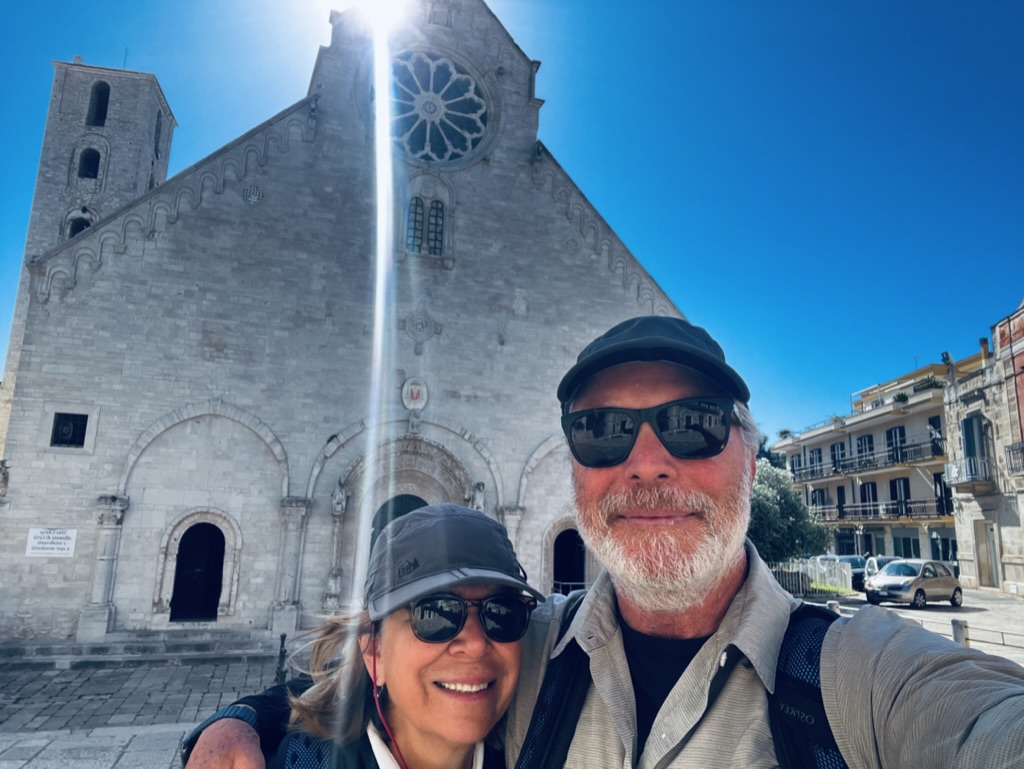
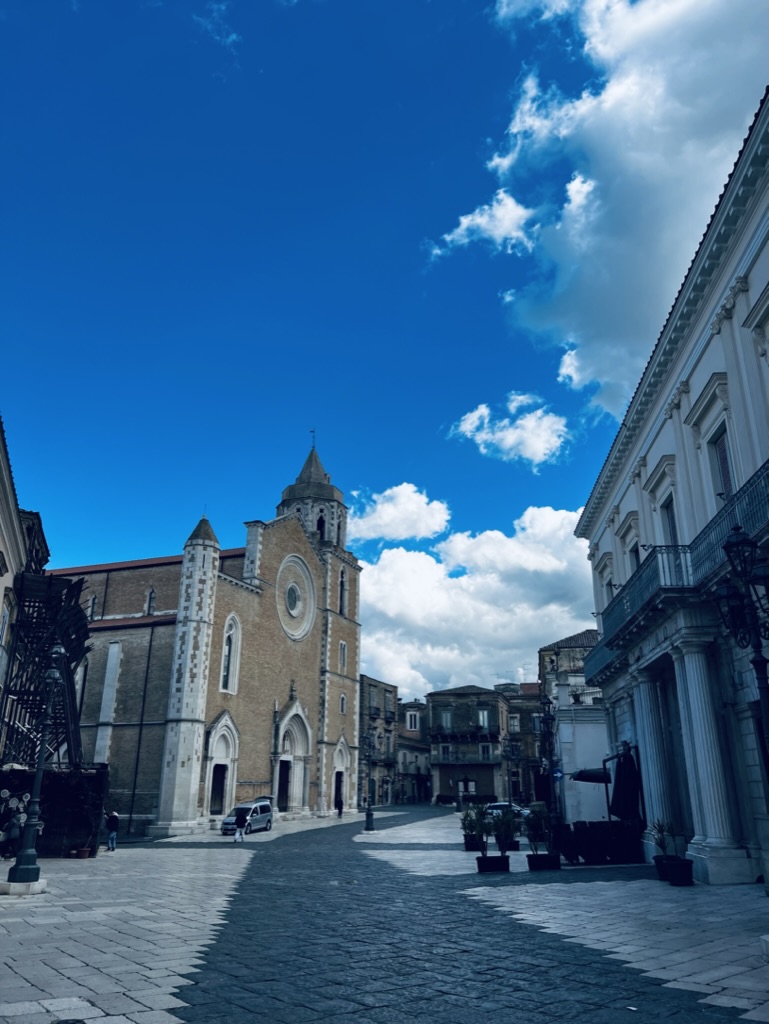
More olive tree grand dames along the straight and flat-ish Via Traiana.  We arrive in Bitonto early enough to pause for an aperitivo in the piazza by the Duomo, a magnificent 12th century Romanesque church with impressive arcades supporting an extensive loggia along its entire length.  The front façade projects structural dignity though the details are worn by the elements over time, a process with which we are becoming intimately familiar.  Like other towns we passed through in the last week, Bitonto’s historic center preserves its original medieval configurations, without the open sewage.  It renders a level of proximity and even intimacy to city dwelling that is hard to resist. 

Tonight, we rest in a small B&B, an old structure that is decorated with 18th century elements from which we expect Vincent Price to greet us.  But we had an excellent dinner, including Linguini Vongole Lupini and a fine Verdeca so we will sleep well. 

Pope to Puglia Day 28 Andria to Ruvo di Puglia – 29km

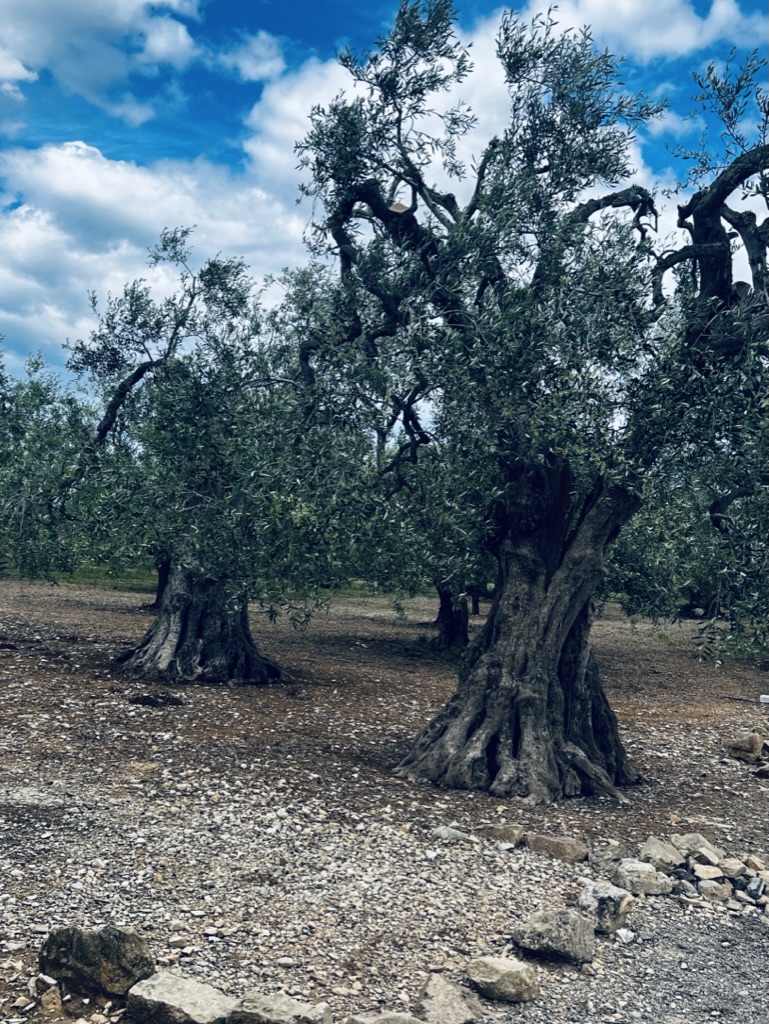
A long day on the Via Traiana, the old Roman road that connected Benevento to Brindisi, as straight a road as the Romans knew how to build.   We walk through olive groves of century-old trees serenely splayed like reclining royalty on manicured fields.  After a while, the monotony of tree after tree becomes soothing, a visual mantra, and the intermittent shade refreshes even under the hot sun. 

We stopped in Corato, a hub of olive oil production, for our usual lunch – a sandwich and orange, in Corato’s lovely center square.  This was supposed to be our stop for the day, at km 14, but our intrepid navigator, yours truly, decided to combine 2 phases.  So, after our brief respite, we soldiered on for another 15 kms.  The time went by quickly, urged on by gathering storm clouds that unleashed wind and rain just as we reached our destination.  We tucked into a trattoria for a simple dinner before retiring for the night.

Paula’s Weekly Summary: Pilgrim’s Progress into Week 5

The mountains are behind us, a lasting memory of beauty and testament to endurance. Some of you have mentioned being reminded of the Sound of Music and Julie Andrews as we described our ascent.  Trust me, Julie Andrews isn’t going to get your ass up that mountain.  You need the heart thumping, foot stomping, leg warmer 1980’s music of Donna Summer and Gloria Gaynor.  Bad Girls all the way.

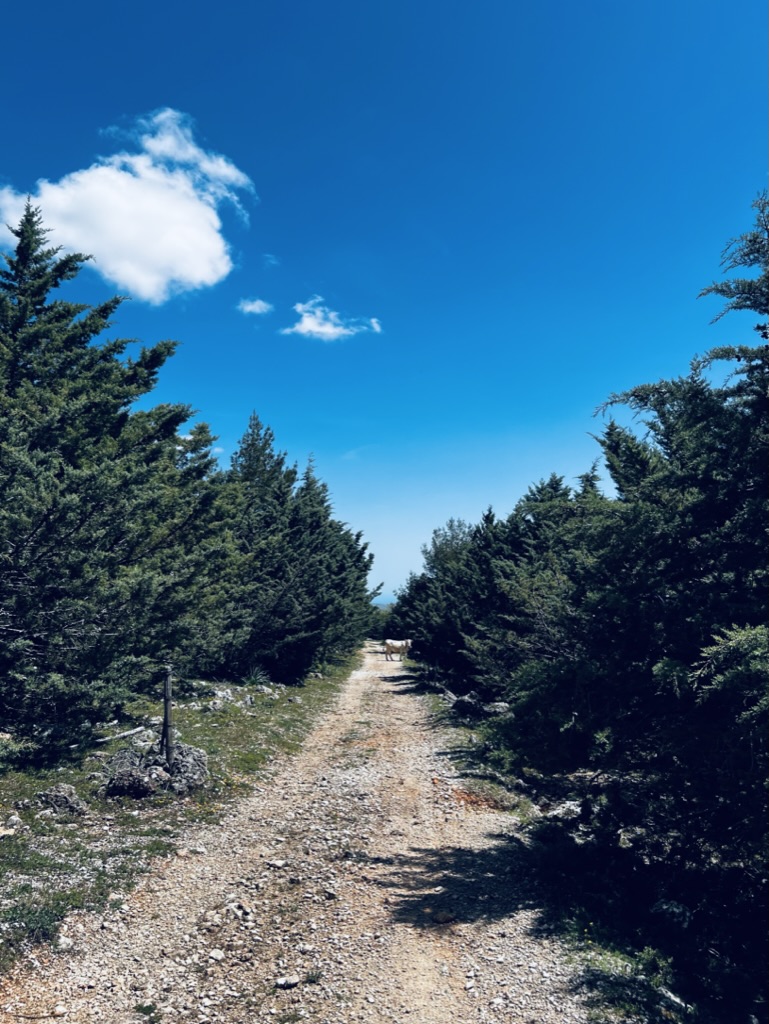
While we were cresting what seemed to be an endless climb challenged by obscure or non-existent signage, I heard in the distance what I thought was the pounding of a drum circle.  As we grew closer, I realized it wasn’t drums it was bells, cowbells which were proportioned to the size of the cow s. They were creating an opera worthy of Philip Glass. 

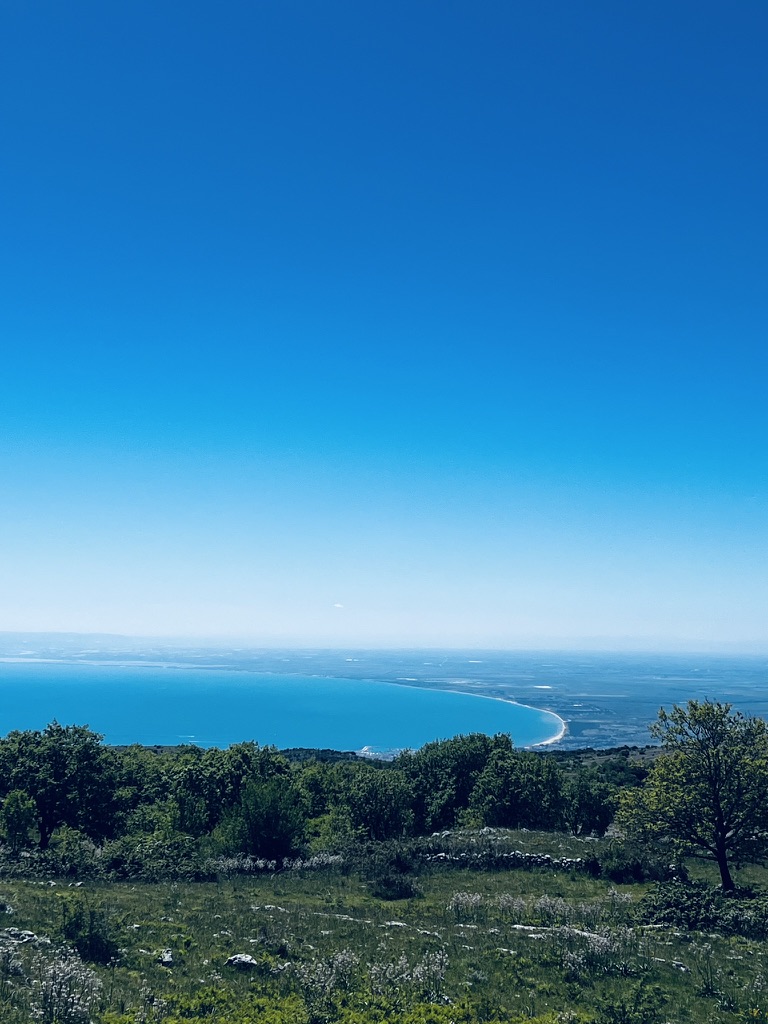
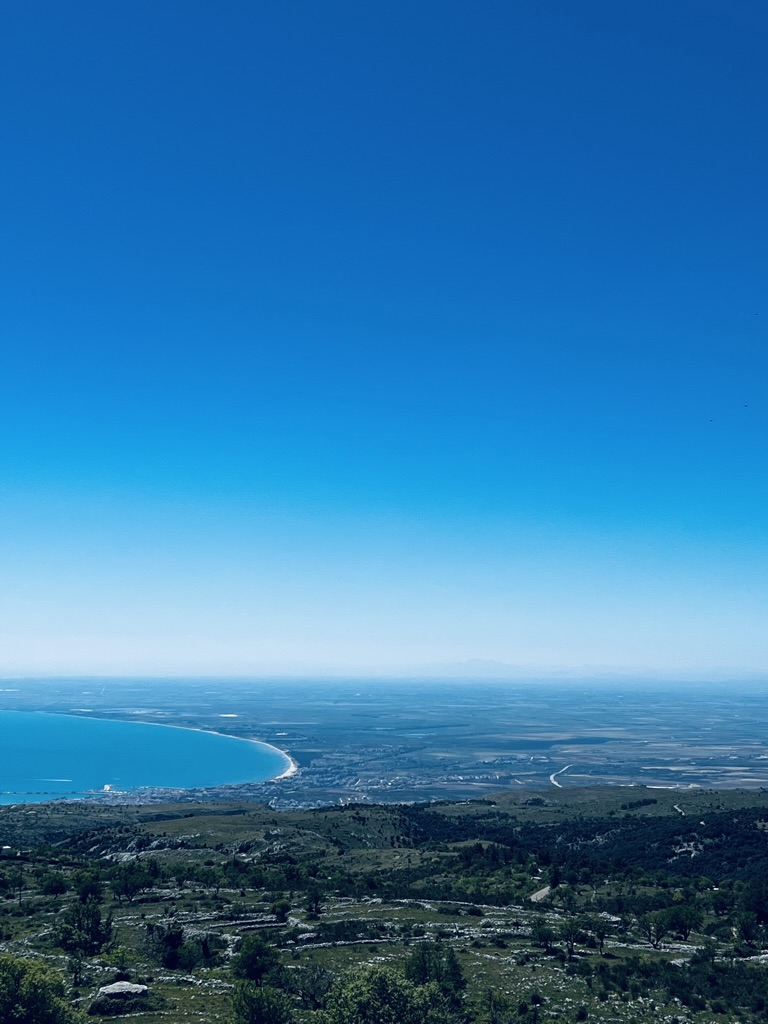
The cows, literally a herd, were standing astride the Via Francigena path.  We stood, looking at each other, the cows glaring with an attitude of pure entitlement, chewing.  I returned their look with confusion, wildebeest and zebra meet cow what is the protocol?   We surrendered the path, bovine 1, human 0.  Finally, we reached the summit and glimpsed the full array of our 24-day journey, mountains, plains, sea.

Following the ascent, down we go to San Giovanni Rotondo, the home of Saint Padre Pio.   It was like being dropped into a CPAC convention, I was met with familiar nods of recognition – they think, that I think, like they think. Exit.

We are now in a labyrinth of olive trees and grape vines.  We’ve been in Puglia only a couple of days but have noticed a greater level of intimacy in our interactions with Puglians.  People stop us, curious tainted with a level of concern.  “Do you want a ride?” “Do you need water?” A man stopping to warn us that the people in the next town are all crazy.  An elderly lady noticing our walking sticks asked “But, where are you going, where will you sleep, are you hungry?”  Edward answers in his perfect Italian, camouflaging our nationality. I prefer to be exposed as an eccentric American rather than a mascaraed as eccentric Italians, so I throw in a couple of “Gee, that is crazy” or “Oh, that is great” forcing the next question “Where are you from?” And their response “oh I have a cousin in New York.”

As we leave the forest and the trees and the vines, I, perhaps, over-romanticize the small scenes we have walked through almost every day: the butcher folding the paper around my sandwich with the precision of military corners; the blue and pink ribbons tied with pride to gates and doors announcing the birth of a baby; the greetings exchanged between young and old with two kisses; sitting on a log or stone wall for lunch; the pilgrims pedicure, culling calluses on curbsides.  I can even romanticize the dinner, when no other option existed, in a wedding venue, just us 2 and the chef proudly serving his pasta specialty, fish head stuffed with meat.  Recently I observed a nonna in the center piazza dragging her grocery trolly while yelling in her phone “cipolle, pane, pomodori e basta!”, the trolly like a large hare being pulled by its ears, while directly around her four cars making their bespoke version of a U-turn.  Then there are the dogs barking everywhere.  Some behind gates, some behind doors, on balconies, in cars, or chained to their dog houses.   The little ones bark way beyond their weight class, the older ones stay reclined lifting only their heads to bark an alert.   There was a pair, a Mutt and Jeff duo, that followed us for nearly an hour.  The small ones are my favorites, hidden behind stone walls, barking madly, the top of their heads momentarily visible as they jump, apparently hoping to leap the wall.   There was even a dog sitting on a lap at a restaurant yesterday that raised its head long enough to offer a few earnest barks.  There is an old Lebanese saying, “The dogs bark, but the caravan moves on.”

The wildebeest and Zebra are lopping on.

Happy Easter to those of you, like me, who follow the Julian calendar.

Pope to Puglia Day 26 and 27 Cerignola to Canosa di Puglia – 20 km Canosa di Puglia to Andria – 25 km

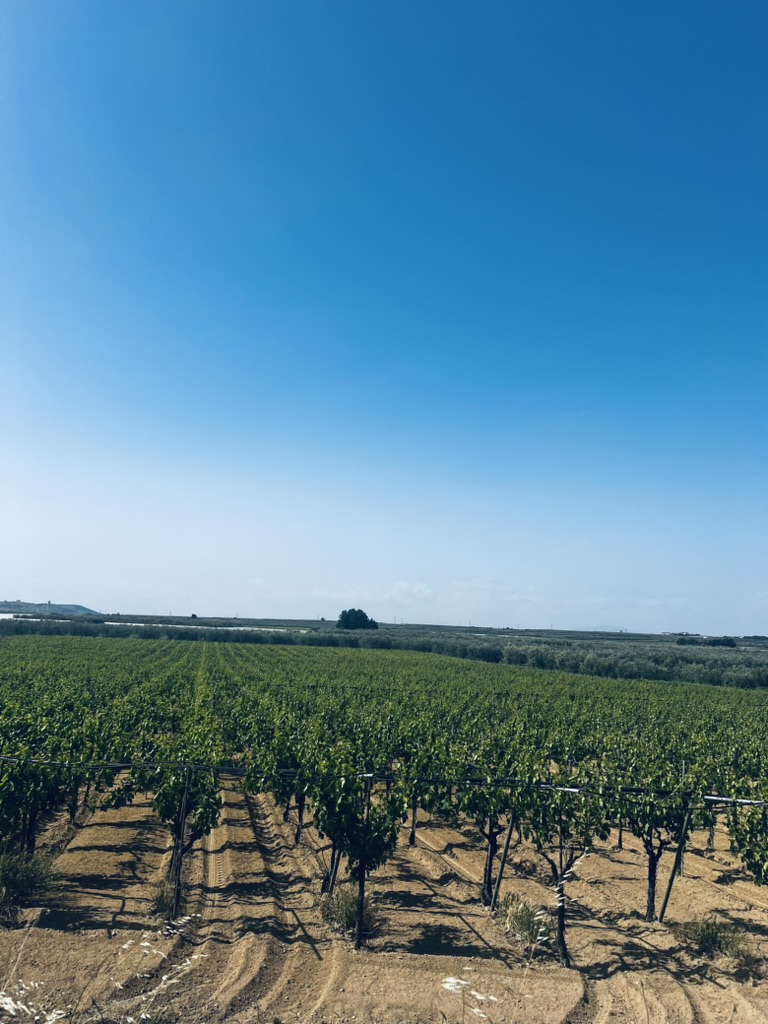
We left the mountains to return to the “tavaliere”, the flat-ish plain between the Apennines and the Adriatic, and the main Via Francigena route.  Our path over the last 2 days mostly has been through olive groves and vineyards.  Miles and miles of them.  The olive trees, gnarly and knobby, hardly resembling trees at all, many of them hundreds of years old, persist stubbornly through wars, earthquakes, storms and scorching hot weather, on rocky arid ground, to produce a delectable elixir.   A great paradox of nature.

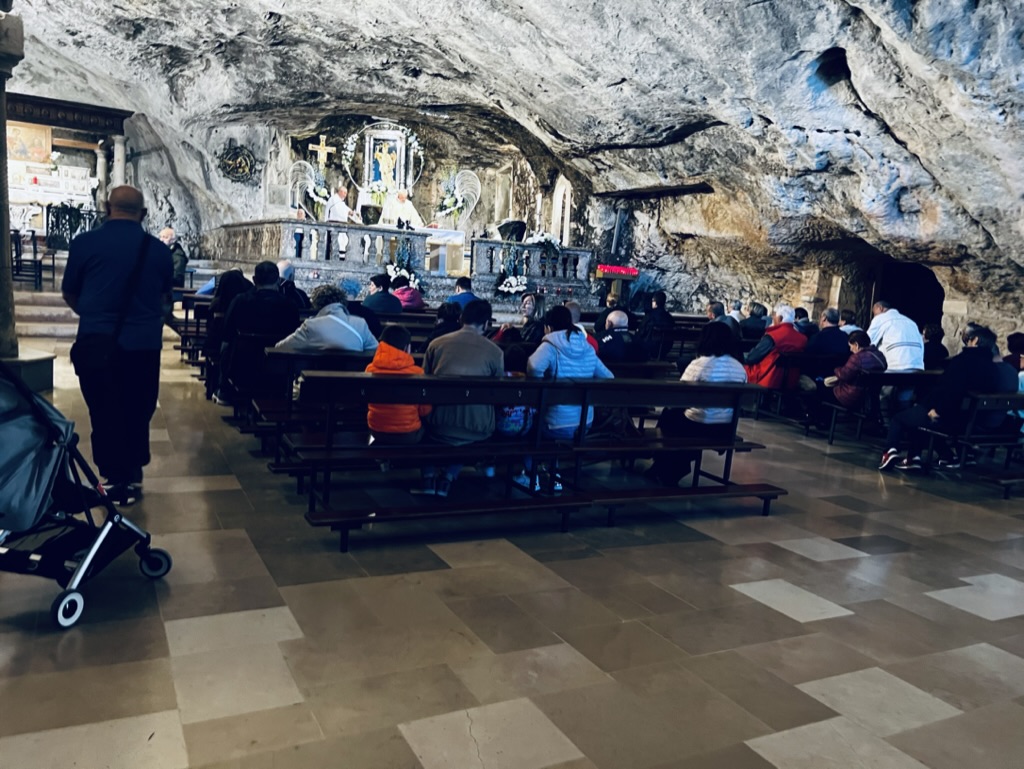
Before leaving Monte Sant’Angelo, we visited the grotto where, legend has it, in 492 CE the Archangel Michael appeared to a local shepherd proclaiming that anyone who visited the grotto would have all sins forgiven.   So, we have that going for us.

Puglians are unusually welcoming.   Many stop to ask us the usual questions: where you are going, where are you from, where are you staying tonight, etc.    But some want to develop a relationship.  On the way to Canosa we crossed paths with Francesco, on a tractor, straight out of central casting for a movie about harvesting.  He explained the virtues of Puglian olives: “The best olives in the world are the Coratina olives from this area.    Tuscans blend Coratina olives with theirs to give their olive oil flavor and the afterbite.    And we have the best wines.”  He has cousins in Florida.  He shut off his tractor, ready to talk for the rest of the day, but we pushed on.  On our way to Andria today we were stopped by Riccardo, also riding a tractor, and obviously trying out for a movie about harvesting.  He wanted to make sure we were ok, invited us to refill our water bottles with water from his 500 m deep well.  It was pretty good.  He insisted I wash out my arm, which I scraped during a maneuver I will not bother to explain here, with the clean fresh water from deep in the ground.  He told us about his 14-year-old daughter who wants to go to America.  We could have had dinner with him if we asked.   

As we walk, we are listening to, Paula enduring, the history of the crusades by Zoe Oldenbourg in which we learn about Bohemond, a Norman leader who became legendary for his physical appearance (he was extraordinarily handsome according to Anna Komnene, the Byzantine emperor’s daughter), strength, courage, military genius, and knowledge about Byzantium.  He is buried in Canosa where his Norman-structured octagonal mausoleum is found.   By the time we got there it was closed.  We enquired at the tourist office where Daniella cheerfully called the local priest who has the key.  The priest, Don Filippo, agreed to come over to open the Mausoleum for us immediately.   I love this culture of the generous spirit. 

Pope to Puglia Day 25 San Giovanni Rotondo to Monte Sant’Angelo 12 km

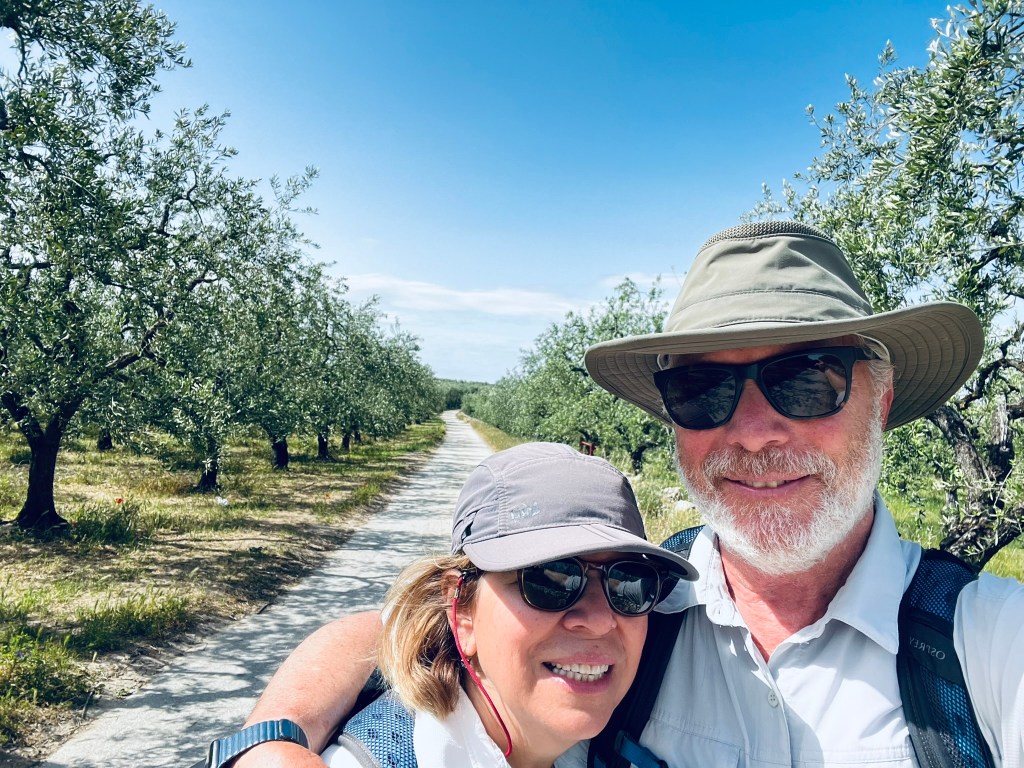
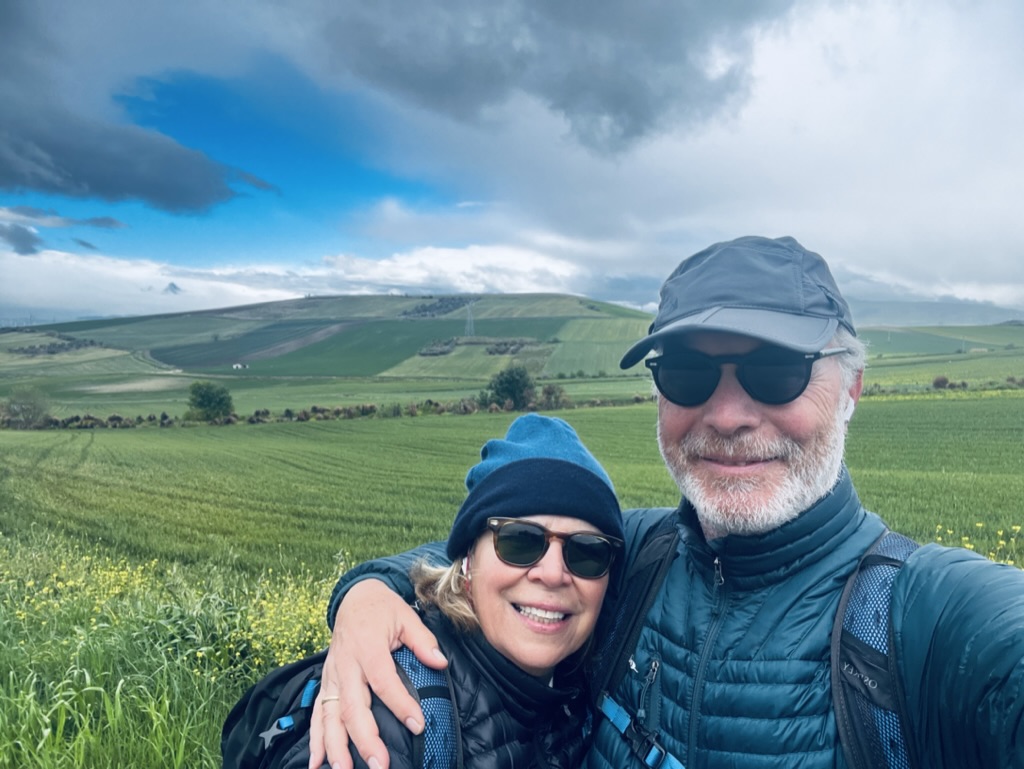
Today we crested the Gargano, the last mountain range we cross on the Via Francigena.  Since we started in Canterbury we crossed 4 ranges: the Jura, the Alps, the Apennines (2x) and now the Gargano.  We walked 1,421 miles and climbed 158,579 ft.   We have another 400 miles to go before we reach the tip of the heel of Italy at Santa Maria di Leuca, most of it flat by the Adriatic.  Reaching this point was emotional for both of us.  I could not have imagined doing this six years ago as I lay recovering from by-pass surgery. I could not have hoped for a better companion, Paula, the love of my life. 

And so here we are, surrounded by some of the most stunningly beautiful scenery, in a town that celebrates the apparition 1,700 years ago, of an Archangel who was dedicated to fighting evil.  We are most grateful.

PS: In a long series of unpredictable coincidences in our travels, I note that yesterday, at the end of his master class on the history of the Via Sacra Longobardorum, Antonio introduced us to his grandson, Edoardo, who, he explained, was named after Edoardo Di Filippo, the famous Italian playwright.  It just so happens that our daughters went to school and became close friends with Tomaso Di Filippo, his great grandson.

Pope to Puglia Day 24 Stignano to San Giovanni Rotondo – 22 km

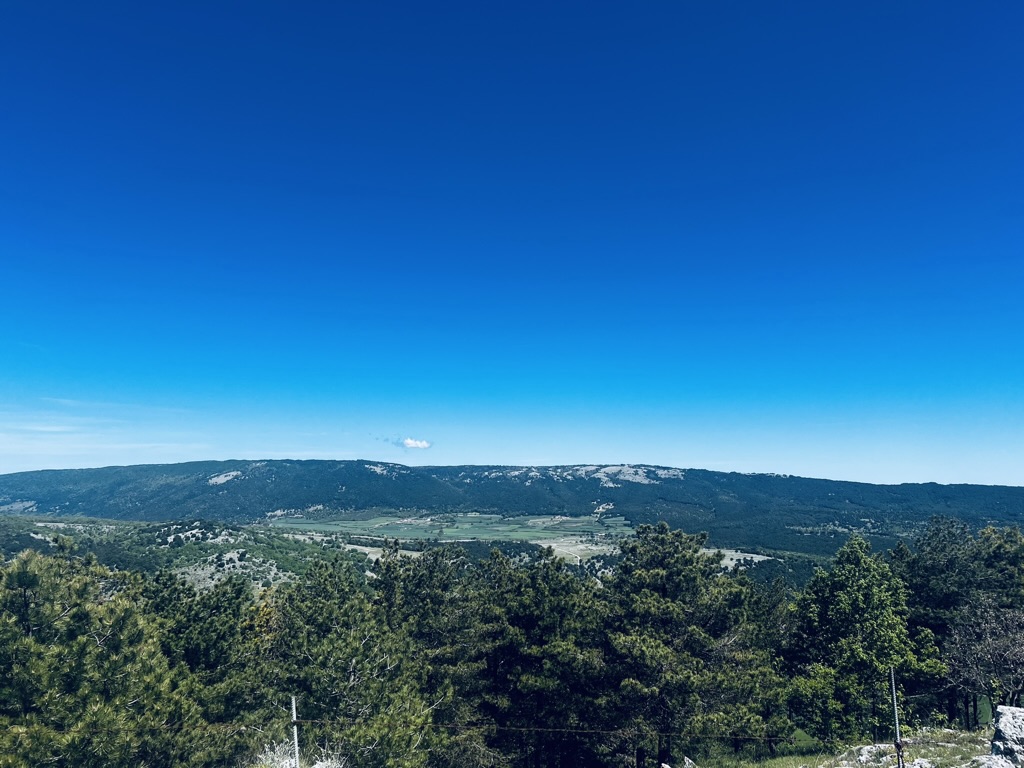
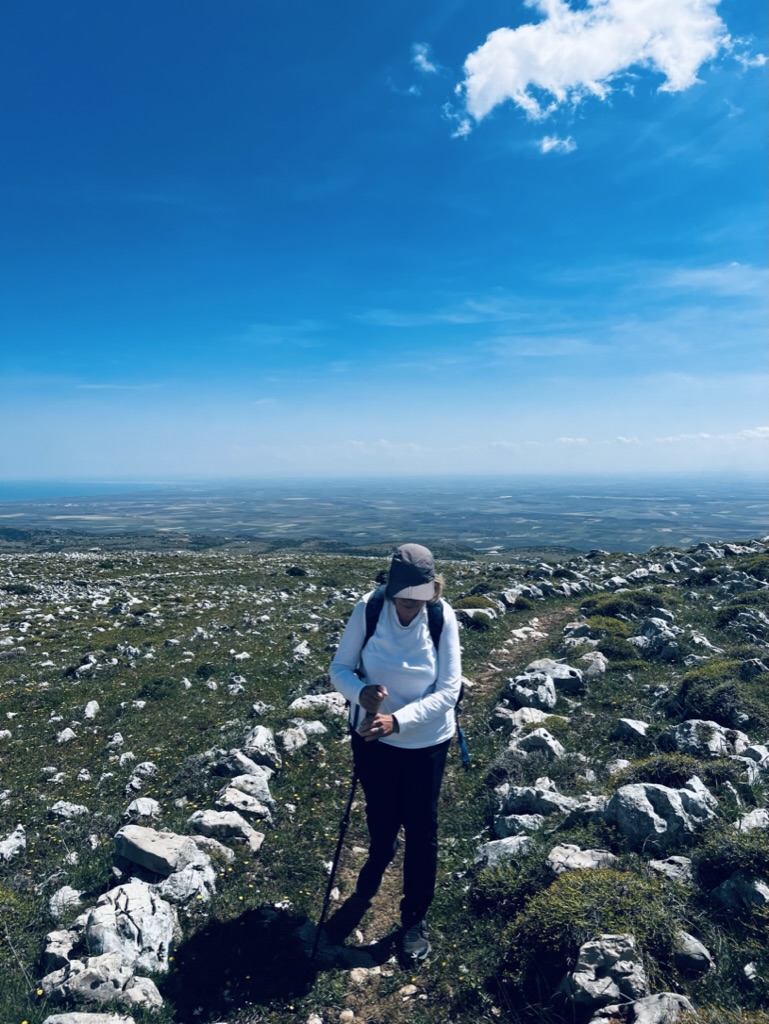
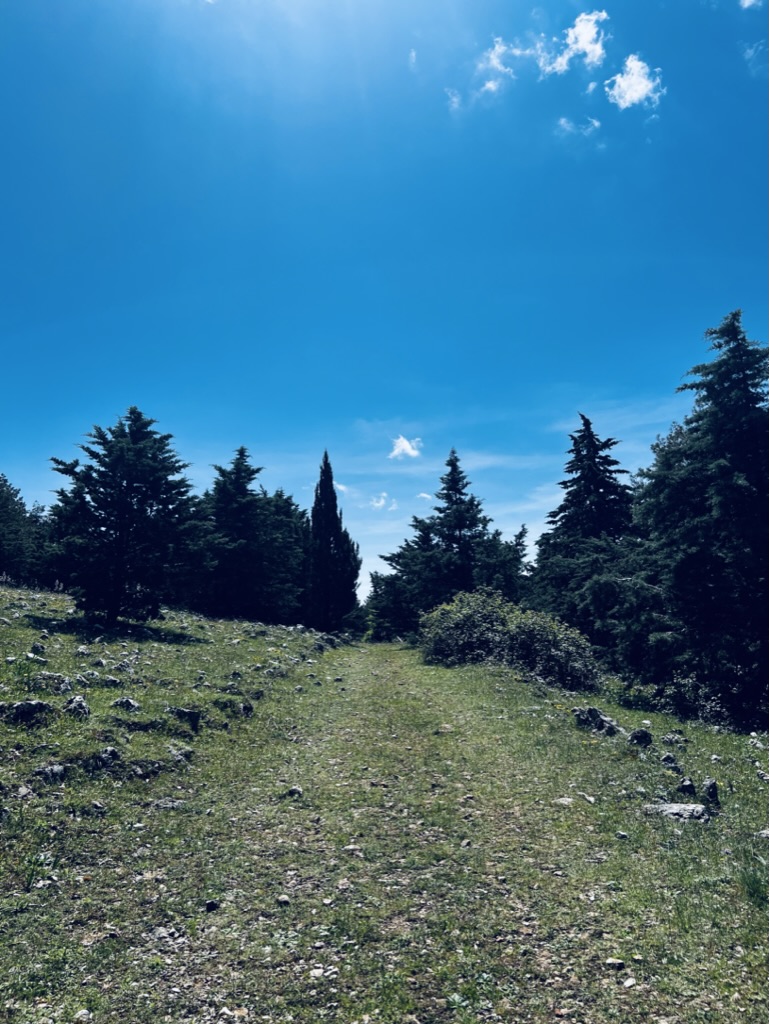
In San Marco in Lamis, Antonio delivered a 15-minute master class on the history of the area.  The Longobards, who were probably from Saxony, swept down into Italy in the 6th century because they heard about the temperate climate, good food, fine wine and the thermal baths.  They Christianized one of their pagan gods to become St Michael, the Archangel, who is often depicted with blond hair, sword aloft ready to strike a serpent.  The road we are walking, called the Via Sacra Longobardorum, has been travelled for over a thousand years by pilgrims on their way to the cave of St Michael at Monte Sant’Angelo, where we will be tomorrow.  In Catholic teaching this cave is one of the three pilgrimages needed for salvation, the other two being St James of Compostela and Jerusalem.  Armed with that perspective we set off for what turned out to be one of the most magnificent walks of our entire journey through pine forests, cow pastures, fields of wildflowers, up 3800 ft to a crest from which the Adriatic Sea was shimmering in the distance. It was breathtaking.

Our stop this evening is the town of San Giovanni Rotondo, where Padre Pio lived most of his life.  It is packed with religious pilgrims who flock to his sanctuary for divine intervention, apparently on a par with Lourdes.   Stores hawking religious figurines and relics line the streets, busloads of supplicants crowd the sanctuary, a sense of subdued hysteria permeates the area.  We retired to the historic center where the heart of a prosperous medieval Italian town beats unabated. 

Pope to Puglia Day 22 and 23 Lucera to San Severo – 28 km San Severo to Santa Maria di Stignano – 22 km

The valley opens before us like a puddle spreading from an overflowing bathtub.  Row after row of olive trees and vines for most of the 28 kms to San Severo which is a small but charming town that was sealed tight for the 25th of April, a national holiday celebrating Italy’s victory over the Germans in WW2.  We settled for a pizza place that happened to have very good food.   After San Severo luxuriant fields of fava beans, wheat and asparagus, the latter being worked by people from Africa, many from Ghana, on hundreds of electric carts.  Ghanaians gathering greens from golfcarts on the Gargano. 

The Gargano massif, which we will climb tomorrow to San Giovanni Rotondo, looms 4000 ft over us, a challenge to our stamina and endurance.

Paula’s Weekly Summary Pilgrim’s Progress into Week 4

We continue to avoid criminal behavior, in fact, we have been seriously pursuing good judgement.  We do not want to lose our baby-sitting privileges when we return home.  Two examples of this new virtuous life: 1) when we enter heavily trafficked roads we remove our ear pods, a pair of which we share so we can listen to the same book and music; 2) I refrained from stopping in the middle of traffic to pick up a colorful bug carcass to add to my collection

At times we cannot avoid walking along busy motorways.  When we step onto the pavement we transform into mythical figure with enormous antennae, oscillating eyeballs, conch-shell-like ears that enable us to hear approaching vehicles and assess size, weight, and the driver’s disposition. These assessments are communicated through a series of grunts and appropriate action is taken.  Never underestimate a middle-aged woman driving a Fiat Panda.

While I have exercised restraint about collecting on busy roads, the path continues to provide a wide inventory.   The rusty metal collection of barbed wire and loppy bits has grown significantly.  These pieces scream to be part of a jewelry ensemble: chockers, bracelets, maybe a tiara. I could sell these pieces and include a tetanus shot with each purchase.  Just an idea.

The ceramic pieces, my “progress artifacts”, nearly outweigh the rest of my suitcase.  I have tried to be a more discerning collector. Pieces collected in the early hours of the day are more capricious but as the hours accumulate retrieval is challenged by all body parts.  You see I’m a basic 5-to-6-hour walker.  When we are going on 8 hours I start seeing Jesus on toast.   Things break down. The debate goes something like this: I spot a nice shard. Head says, “I think we have that already.” 

Knee, and hip weigh in “You going to bend down for that?” 

Left knee “Oh no, please.” 

Right knee “But it’s just white with a few dots!”

Hip, “Agh, she is going for it.”

Arm, “I got it, don’t worry.”

My body emits a sound like the deep groan of metal on the Titanic when the ship breaks in half.

I’m no prima-donna when it comes to accommodations.  One of my earliest recollections regarding this fact goes back to high school. A friend and I rented a bedroom room in Ocean City through an ad.  We discovered upon arrival that the “room” was a camper parked in a garage with a dog chained to the hitch.  You adapt.

The criteria for choosing accommodations on our walk is primarily proximity to the Via Francigena path.  These are often very limited.  After 132 overnight accommodations on the Via Francigena, statistically it was likely one would be unacceptable, and it finally happened.  No further details are necessary. We have had the full Kubler Ross range of room types.   My favorite room on the phase resembled a chic public storage unit.  No windows, a gray and black palette, and a paneled frosted path divider between the room and bathroom. It had an amazing stock of Malin&Goetz soaps.  One problem, condensation when using the shower created a cascading water element on the walls creating puddles on the floor.

A clarification is in order regarding “Norman Towers Spa” in Casalbore.  Some may have misinterpreted the term “spa” based on congratulations for a nice cozy respite. In Casalbore Spa means a big hot tub in a crazy tricked out room.  The hot tub faced a large TV projecting a burning fireplace and was adorned by multi-colored ceiling lights.  The ceramic tiles on the wall depicted Vesuvius and Niagara Falls. None of the usual spa amenities were offered, no puffy slippers, no thick towels, no lavender spray for your pillow, no music replicating dolphin chatter.  The lovely owner, Valario, confided that the “Spa” was very popular with local clients of his bar.

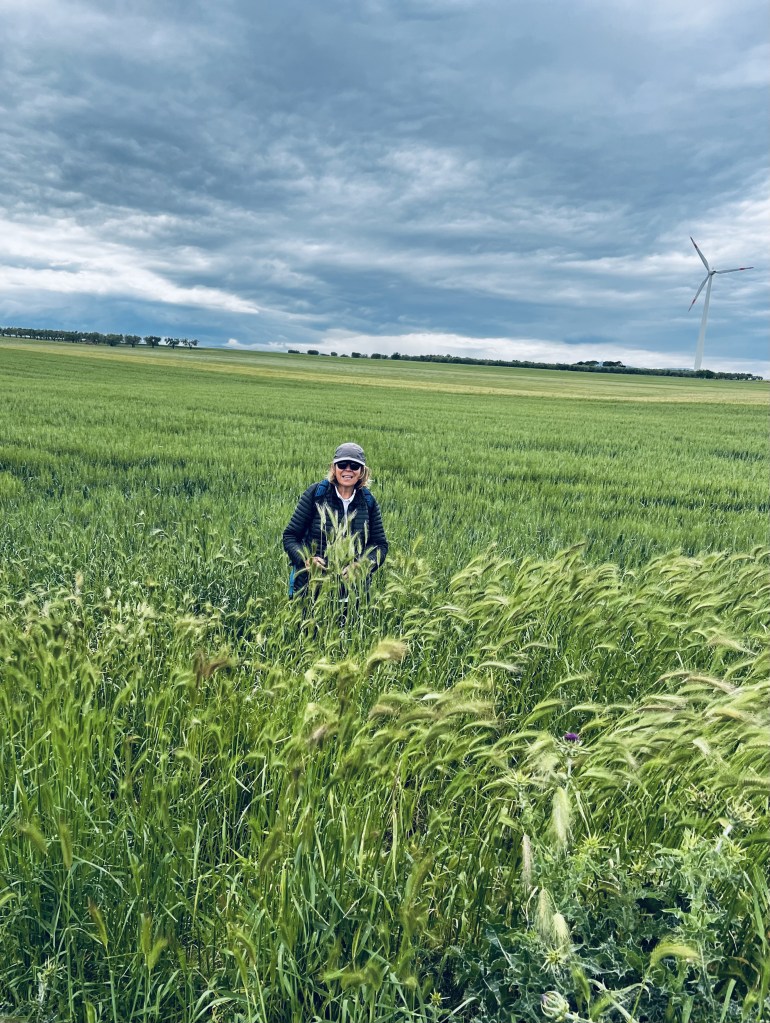
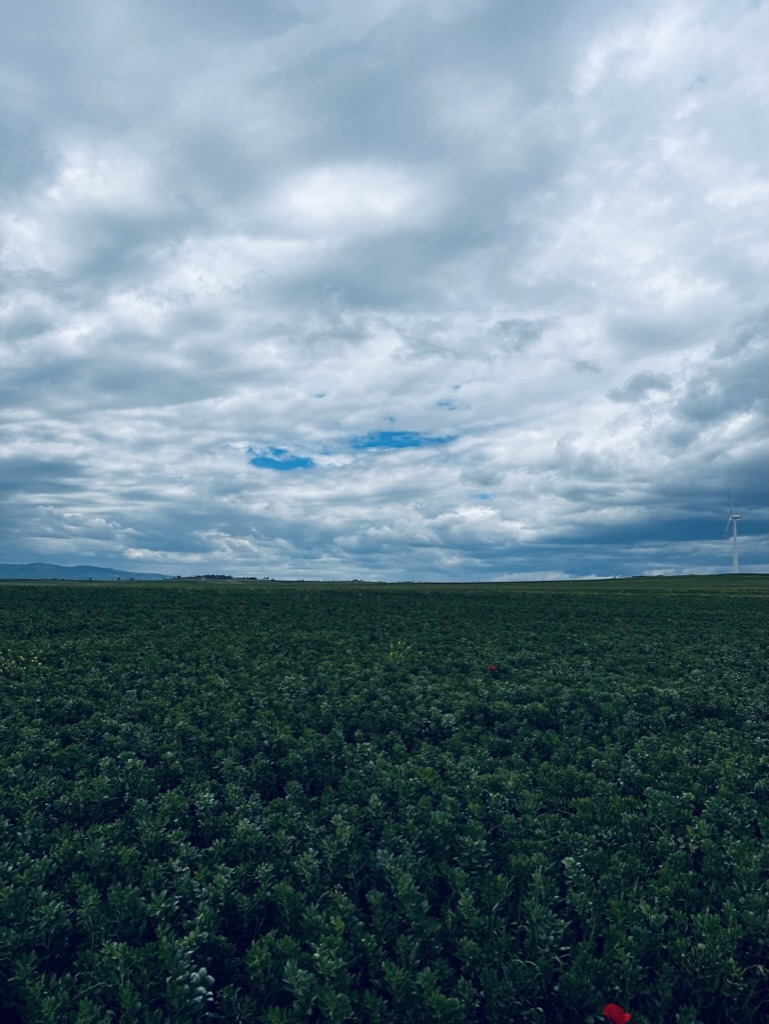
The weather this week was challenging, cold rain and wind most days, but the past two days tendered a spectacular apology. We were treated to a dramatic display of Puglian agriculture.  We walked through waist high wheat and fava beans, often without a visible path, just pushing through these gorgeous plants. Acres of flowering fennel that looked like fluffily green moss was our next host.  We meandered among bent and twisted olive trees, which resembled menacing characters in children’s fairy tales.

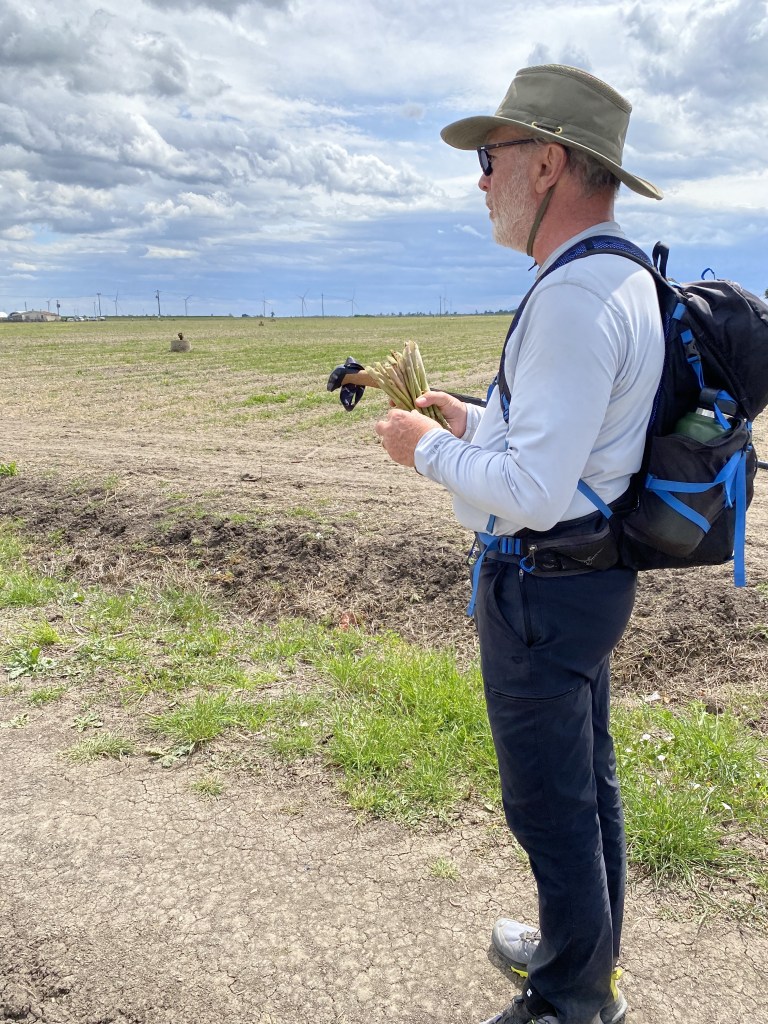
But today was a gift.  After our GPS failed and no signage, we were marooned in an endless field of asparagus without horizon.  African men, sitting close to the ground in hundreds of electric, canopied go-carts straddled the rows of the plants, cutting asparagus shoots with a simply paring knife.  We took great interest in them, and they took great interest in us.  After a while the carts stopped, men got out, took off their shoes, knelt and bowed touching the ground for mid-day prayer.  We learned that the workers were from all over Africa, some from Ghana, some from Mali, some from Zimbabwe.  One harvester asked me “Where are you from? What is your name?  Where are you going? How many kms did you walk today? How old are you?”

We were still confused about where we were until we spoke to Angelo, who gave detailed direction and an armful of freshly cut asparagus which we savored as we found our way back on the path.  
Pope to Puglia Day 20 Troia to Lucera – 18 km

The paneficio (bakery) was bustling this morning at 8 am with people milling about cheered by the aroma of freshly baked bread. It’s the smell of home, family, a good meal and a warm fire.  While waiting for our focaccia, we said hello to two young men whom we had seen back in Benevento. We exchanged vital info – where to, they to SMDL; where from, they from Brescia in norther Italy – but otherwise they seemed to want to be left alone, which suits us fine.  We surmise they are seminarians or just good friends or both. 
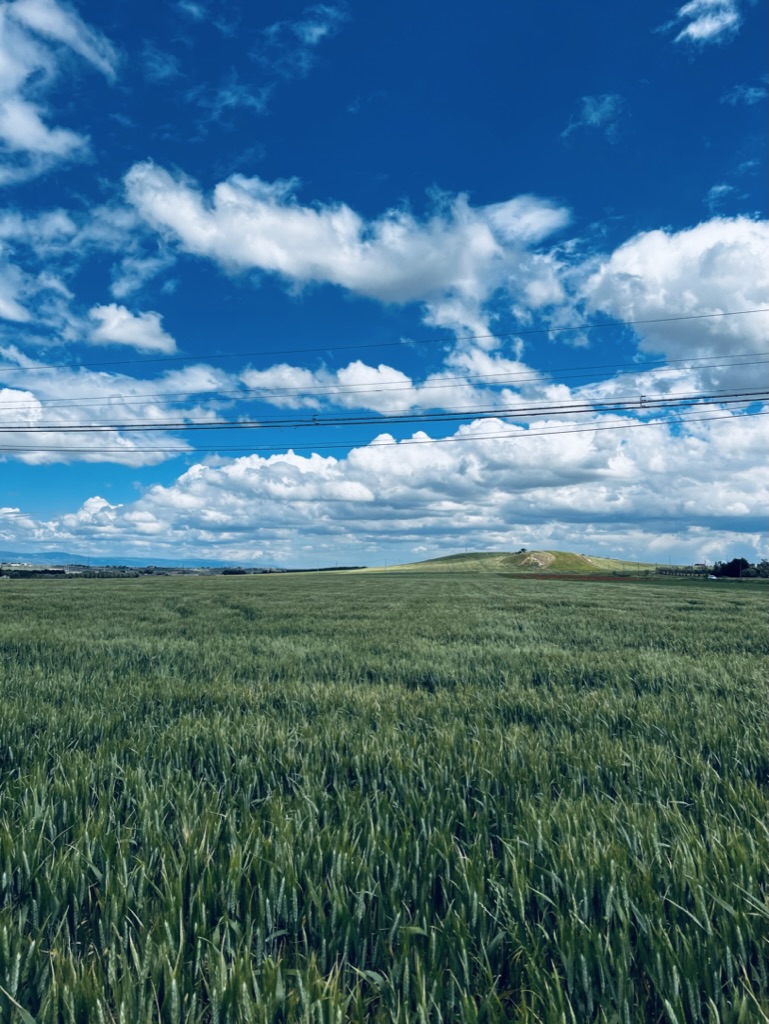
The variable weather means constant change of outer wear from goose down jackets (it was chilly this morning and the wind was blowing) to rain slickers, to just shirts and then back to the jackets. At the beginning of one downpour, a lady stopped her car to offer us a ride.  Though tucking into a warm dry car was enticing, we politely refused.  We were in the mood for a walk and the endless fields of wheat and olive trees are soothing. 
At Hannah’s suggestion we listened to Ezra Klein’s interview with Adam Moss, the former editor of New York Magazine, on editing and its role in the creative process. Klein is always thoughtful, but this piece is very insightful especially on the relationship between motion (running, cycling, walking) and creativity.  Our walking helps us focus more intensely, even if on nothing.